August 30, 2026 · 4 min read
Why first drafts stop at chapter four (and what finishers do differently)
Claire Tarn
Publishing Editor at Psitta
Almost every writer has a drawer like this. Sometimes it is a real drawer. More often it is a folder on the computer with a name like "Book stuff." Inside there is a manuscript that stops around chapter four.
Not chapter one. Chapter one is easy. It comes with excitement, and many writers rewrite it five times before chapter two even exists. And not the ending, because the ending is never in danger — it stays safe inside the writer's head, complete and beautiful, where no bad sentence can touch it.
Chapter four is where drafts go quiet. It is far enough from the start that the first excitement is gone, and far enough from the end that finishing still feels like a dream. If you have a stopped draft, I am almost sure it stopped somewhere in that region. Mine did, more than once.
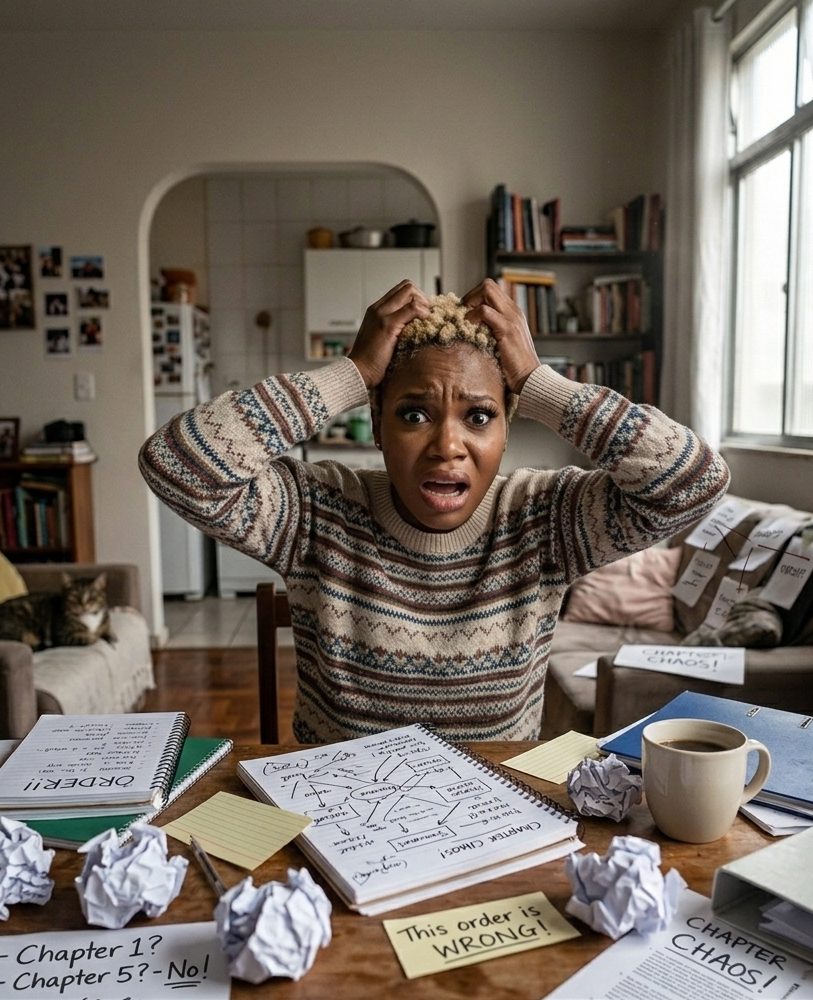
Here is the strange part: the writers who finish are not so different from the writers who don't. They are not more talented, and most of them do not have more time. After years of watching both groups — and being part of each one — I believe the difference comes down to three habits. None of them is about writing better sentences.
Finishers separate the draft from the book
The writers who stop are almost always trying to write the book. The writers who finish are only trying to write the draft. For them, these are two different things.
The book is the one in your head: deep, moving, the one your favorite author could have written. The draft is a long, imperfect document with only one job — to exist. When you judge the draft using the book's standard, chapter four is exactly where the distance between them becomes too painful. By then you have enough pages to see clearly how far the words are from the vision. So you stop. Or worse, you go back and polish chapter one again, which feels like progress but is really a retreat.
Finishers make an agreement with themselves: nothing gets fixed until everything exists. It sounds like discipline. In truth, it is kindness — permission for today's pages to be bad, because bad pages can be repaired and empty pages cannot.
Finishers know what happens next — more or less
You do not need a forty-page outline. Many finished novels started from one paragraph of intention. But the writers who reach the end almost always know, before a writing session starts, more or less what the next scene needs to do.
Writers who stop tend to sit down first and only then decide what to write. That works in the first chapters, when the story is still pouring out. In the middle, it means every session opens with the hardest question in writing — what happens now? — asked exactly when your energy is low and the blank page feels enormous. A few sessions like that, and the project starts to feel heavy. Heavy projects get avoided. Avoided projects become drawer manuscripts.
The solution is almost too simple. At the end of each session, write one sentence about the next scene: "Marta finds the letter but cannot read it in front of him." That is all. Tomorrow's session does not start with a question anymore. It starts with an instruction. You would be surprised how much of "writer's block" is only the absence of that one sentence.
Finishers protect a rhythm, not a word count
Writing advice loves daily word counts, and for some people they work. But I have seen too many writers miss a 1,000-word target three days in a row, decide they are failing, and quietly stop. The book did not kill the draft. The scoreboard did.
What really predicts finishing is rhythm: regular, protected contact with the manuscript, even when the contact is short. Twenty honest minutes on a Tuesday keep the story warm in a way that one heroic Saturday, followed by ten days away, never will. Time away is the real enemy. Every day off makes the return more expensive, and that cost is what makes opening the file feel so hard.
So count presence, not production. Did I sit with the book today? Twenty minutes count. A session where you only reread yesterday's scene and wrote one new paragraph counts. The manuscript does not know the difference between an inspired session and a simple, dutiful one. It only knows if you showed up.
None of this is glamorous. That is the point. A finished first draft is not a monument to talent. It is the result of a few small habits, kept alive through the unglamorous middle, where everything is decided.
If your chapter four is sitting in a drawer right now, it is not proof of anything — except that nobody told you the middle feels like this for everyone. Open the file. Write the one sentence about what happens next. You are closer than the drawer makes it look.
I put the full method — these habits, plus the planning and revision steps that come after them — into a free workbook, the Finish-the-Book Kit. And if you want a writing home built around exactly this way of working, that is what we made Psitta Studio for.
Psitta is the writing studio that helps you go from first idea to finished manuscript.