October 9, 2026 · 5 min read
Dialogue that sounds like people — the ear test

Luis Popi
Founder of Psitta
Here is a strange fact about dialogue. If you recorded two friends talking in a kitchen and typed out every word, the transcript would be unreadable. False starts, half sentences, "um," "you know," three interruptions a minute. And yet when a character in a novel speaks in full, grammatical, well-organized sentences, the reader stops believing in her at once.
So dialogue that "sounds like people" cannot mean dialogue that is accurate. Real speech is too messy to print. Written speech that follows all the rules is too clean to believe. Good dialogue lives in a narrow band between the two: it is an illusion of talk, built from maybe a tenth of what talk actually contains. The craft is in choosing which tenth.
Most writers get this wrong in the same two directions, so let me name them before anything else.
The first wrong direction is the information delivery. Characters telling each other things they both already know, because the reader needs to know them. "As you know, Maria, our father left the farm to me when he died two years ago." No one has ever said a sentence like that to a sibling. The moment a character explains the plot to another character, the scene dies, and the reader can feel the author's hand reaching through the page. If the reader needs the farm's history, give it in narration, where it belongs. Dialogue is for what happens between people, not for what the reader is owed.
The second wrong direction is politeness. On the page, characters answer the question they were asked. In life, almost nobody does. Listen to a real argument between people who live together: it is two monologues colliding. She says the dishes, he says her mother's visit, she says the dishes again but means the mother. Each line is a small swerve away from the last one. That swerve is where dialogue comes alive, because it shows two separate minds in the scene, each with its own agenda. When every character answers cleanly, there is really only one mind on the page, and it is the writer's.
Here is a plain example. The clean version:
"Are you coming to the funeral tomorrow?" — "No, I have to work. I also never liked him."
And the version with the swerve:
"Are you coming tomorrow?" — "I have a shift." — "They can find someone." — "He never came to anything of mine."
The second version is longer and carries less information, and it is better anyway. Nobody names the funeral; both know what "tomorrow" is. The real answer, the old wound, arrives late and sideways, the way real answers do. People speak around the hard thing for as long as they can. Let your characters do the same, and the reader will lean in to catch what is not being said. Subtext is not a decoration for literary novels. It is simply how human beings talk whenever something is at stake.
A few smaller matters, because they come up in almost every manuscript I see.
Tags. Use "said" and almost nothing else. Elmore Leonard put this in his famous ten rules — never use a verb other than "said" to carry dialogue — and he was barely exaggerating. "Said" is invisible; the reader's eye slides over it and stays with the voices. "Exclaimed," "retorted," "opined" each pull the eye to the writer. If the line is angry, the words of the line should carry the anger. "Get out," she said is stronger than "Get out!" she snarled, because the first trusts the line and the second apologizes for it. And when only two people are in the scene, you can drop most tags entirely. A small action does the work and sets the scene besides: She put her cup down. "Get out."
Phonetic accents. Resist them. Dropping letters and bending spelling to show how a character sounds ("Oi weren't doin' nuffink") makes the reader work for every line, and it tends to turn a person into a costume. Suggest a voice through word choice and rhythm instead. A character who says "I was not raised to waste food" sounds different from one who says "we don't throw food out, not in this house," and neither needed a single apostrophe.
Length. In most scenes, people speak in short bursts. A speech of six sentences is rare in life, and in fiction it needs a reason: a character who lectures as a trait, a confession that has waited thirty years. If several characters routinely speak in full paragraphs, the dialogue will read like essays wearing name tags. Break long speeches with interruptions, with the other person's small reactions, with the room.
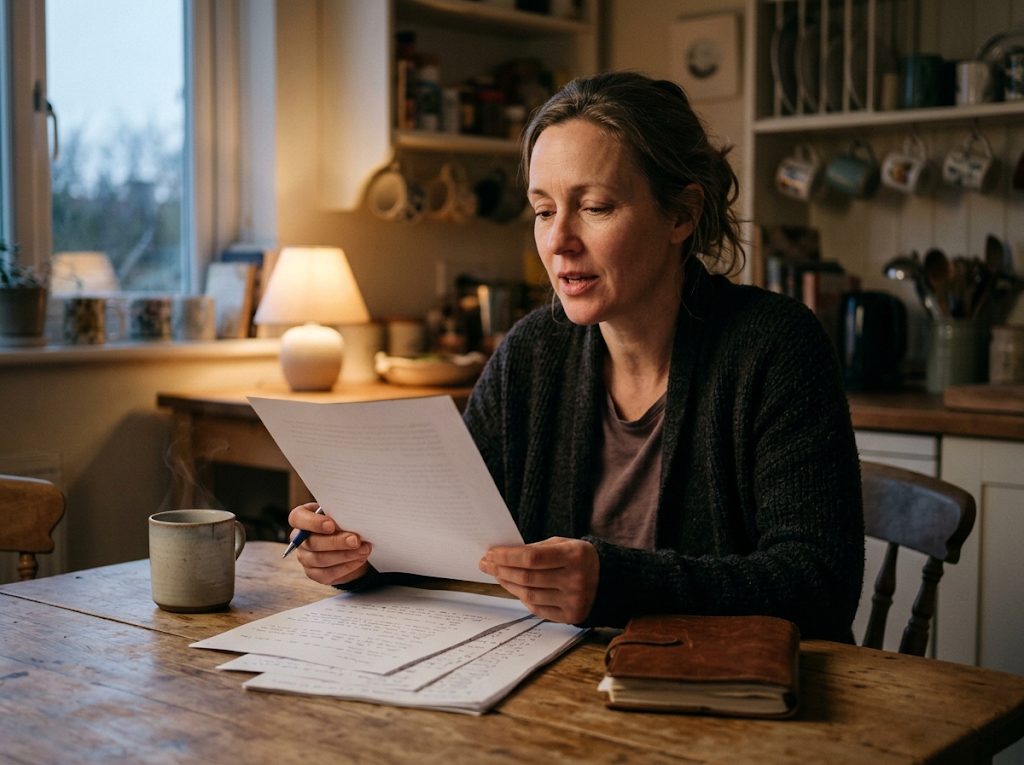
Which brings me to the test, the one I trust over any rule in this post. Read the scene aloud. Not in your head — aloud, at talking speed, doing both voices. I wrote a whole post about reading your draft aloud as a general editing pass, but dialogue is where the method pays double, because dialogue is the one part of a manuscript that pretends to be sound. A false line can hide from your eyes forever. It cannot survive your mouth. You will hit a sentence and feel, physically, that no person would say it; your own voice will refuse the rhythm. Mark the line and keep going. You do not need to know yet what the fix is. The ear finds the problem; the fix usually suggests itself the next morning.
One more thing the ear test reveals, and it is the most useful of all: whether your characters sound like each other. Cover the names and read a page of dialogue from the middle of your draft. If you cannot tell who is speaking without the tags, the characters do not yet have voices — they have your voice, distributed. The repair is not to give one of them a verbal tic. It is to go back to what each person wants in the scene, because people who want different things speak differently without any help from the costume department.
Since I make a writing tool, a small aside, and you may weigh it however you like: one reason we built natural narration into Psitta's studio was exactly this. Hearing a scene read back in a voice that is not your own is the fastest way I know to catch a line no human would say — your own voice, reading your own words, forgives too much. But the method costs nothing. A kitchen, a closed door, and a page read aloud will find most of it.
The dishes, the shift, the thing nobody names. That is what dialogue is for.
Psitta is the writing studio that helps you go from first idea to finished manuscript.