November 7, 2026 · 5 min read
First person or close third? Test the choice in one scene, not a whole draft

Luis Popi
Founder of Psitta
Here is a quiet fact about point of view: most writers do not choose it. They start the book in whatever voice arrived with the idea, usually the voice of the last novel they loved, and they only notice the decision a hundred pages later, when something feels wrong and they cannot say what. Point of view is the one choice that touches every sentence you will write. It deserves one deliberate evening before it gets a year of your life.
I want to keep this practical. I will skip the full catalog of narrators — omniscient, second person, the unreliable cousin — because for most novels written today the real decision is between two options: first person, where the character tells the story as "I," and close third person, where the story says "she" and "he" but stays inside one character's head at a time. These two sit much nearer to each other than the pronouns suggest. Both show the world through one person's eyes. Both can carry a whole book. And still they are not the same instrument, and a scene that sings in one can go flat in the other.
So what does each one buy you?
First person buys voice. The narrator's personality soaks into every line, because every line is theirs — the jokes, the blind spots, the things they refuse to say. If your protagonist sees the world in a way that is itself a pleasure to read, first person puts that pleasure on every page. The price is confinement. You can never show a scene your narrator did not witness. You can never tell the reader something your narrator does not know, which makes certain plots — the ones built on what the hero cannot see coming — much harder to run. And a thin or ordinary narrating voice has nowhere to hide. In first person, a bland narrator is a bland book.
Close third buys room. You can step back an inch to describe your character from the outside. You can move the camera to another character at a chapter break, which first person only manages with awkward labeled sections. You can let the prose be a little better than the character — a bricklayer in close third can be written in sentences the bricklayer would never produce, and no reader objects. The price is a thin layer of glass. "She felt the cold" is always one step farther away than "the cold got into me." Close third can come very near — modern close third is often nearer than lazy first person — but the writer has to work for that nearness line by line.
There are also plain genre habits worth knowing, because readers arrive with ears already tuned. Young adult novels run heavily to first person, often in present tense. Epic fantasy with many storylines almost requires third, because the story is larger than any one witness. Crime fiction splits down the middle. None of this is law. It is only the sound of the shelf your book will sit on, and you should know that sound before you decide to ignore it.
But the lists above are theory, and point of view resists theory. Writers argue about it the way they argue about outlining, in the abstract, forever. The argument ends the moment you run the test. Here it is.
Pick one scene from the book you are planning — not the opening. Choose a scene in the middle, one with pressure in it: an argument, a discovery, a lie told to someone who deserves better. Write it in first person. Five hundred words is plenty. Then put it away until tomorrow, and write the same scene again in close third. Not a translation — do not sit there changing "I" to "she." Write it fresh, from memory of what happens.
Then read both versions aloud, and notice three things. Where did you have more to say? One version usually comes out longer without trying, and that looseness is a sign the voice fits. Where do you trust the narrator? In one version the character tends to feel like a person; in the other, like a camera. And where does the scene's secret sit? If the scene works because of what the reader must not yet know, check which version kept the secret without cheating. First person narrators who hide things from the reader are a famous source of reader anger.
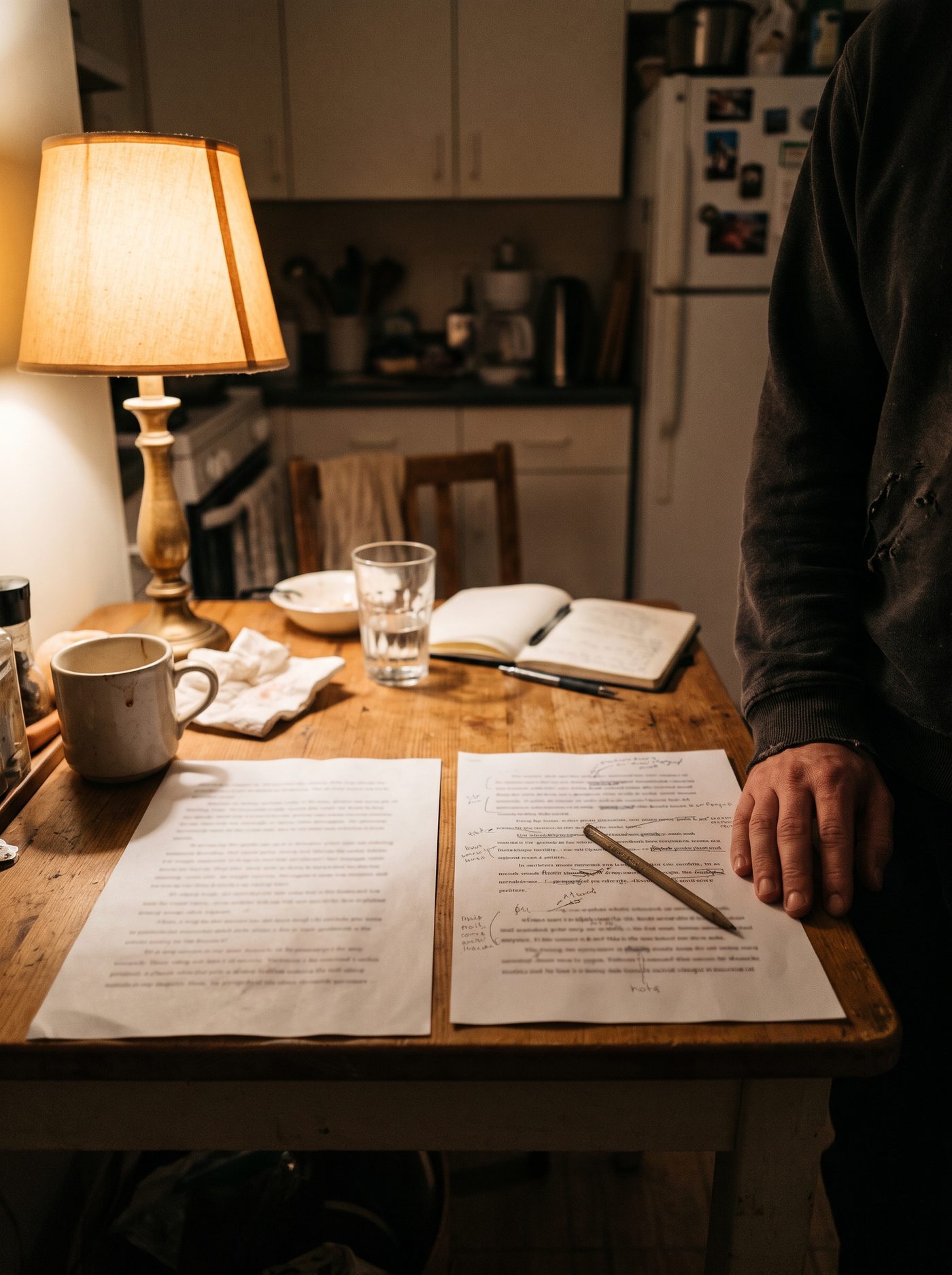
You will almost always have a winner, and the interesting part is that it is often not the version you expected. The idea arrived in first person and the scene came alive in third, or the reverse. This is normal. The voice an idea arrives in is a habit, not a verdict.
Two reassurances before you commit. The first: this decision is serious but it is not fatal. Books get re-pointed. It is slow, unpleasant work — every sentence must be touched, not just the pronouns — but writers do it, usually after a first draft makes the problem undeniable. The test exists so you can learn in one evening what a failed draft teaches in a year. The second: you are allowed to be ordinary here. First person and close third are the common choices because they work. Choosing the same point of view as a thousand good books is not a failure of imagination. It is picking a reliable tool.
One last note, since reading aloud is half of this test. I built a narration feature into Psitta mostly for moments like this one — hearing two versions of the same scene read back in a neutral voice makes the winner strangely obvious, faster than rereading ever does. But any method of hearing the words will serve: your own voice, a patient friend, the kitchen at night. The point is the same. Point of view is a sound before it is a technique. Choose it with your ears.
Psitta is the writing studio that helps you go from first idea to finished manuscript.